
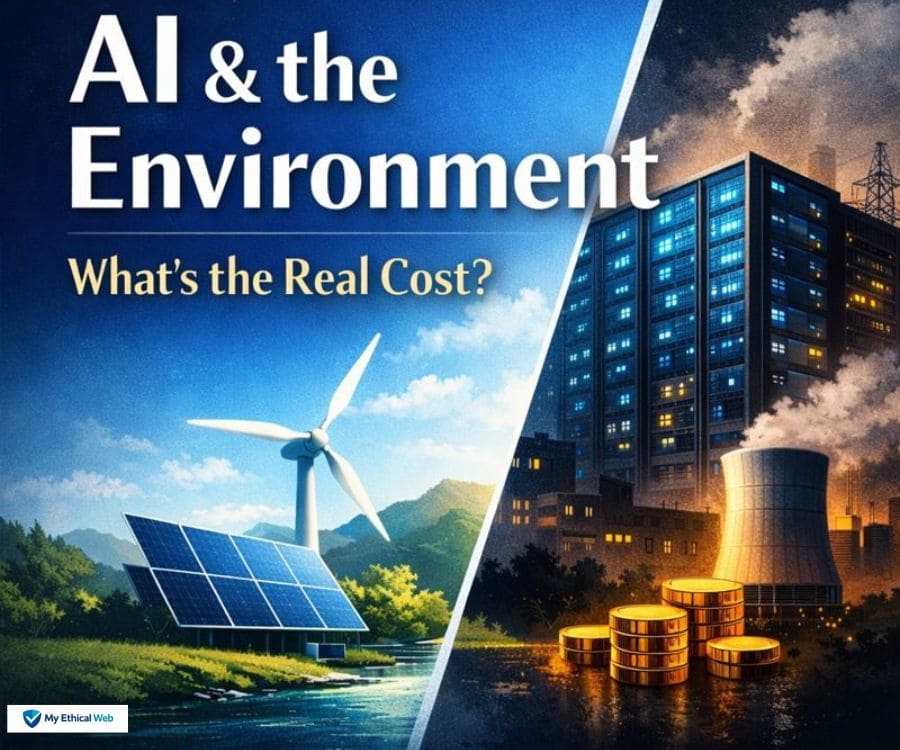
Three browser tabs: ChatGPT open while I was asking it to help explain a 1040-SR tax form to my uncle, Netflix streaming Season 3 of The Office on autopilot, and an article claiming AI prompts were draining reservoirs. Netflix had been running for two hours. The AI query would use less energy than warming coffee.
That contradiction is where this analysis started.
The story changes from “every prompt is destructive” to something far more uncomfortable: individual AI use barely matters. Infrastructure does.
At a Glance: The Real “AI Tax” in 2026
| Activity | Energy / Water Cost | Everyday Equivalent |
|---|---|---|
| Text AI inference (per query) | ~0.003 kWh | Charging a smartphone to ~20% |
| Image generation | ~0.05–0.22 kWh | Boiling a cup of water |
| HD video streaming | ~0.1–0.4 kWh per hour | Running a large LED TV |
| Water usage (AI cooling) | ~500 ml per 20–50 prompts | One high-efficiency toilet flush |
Sources: International Energy Agency (IEA) 2026 projections, Lawrence Berkeley National Laboratory infrastructure analyses, industry disclosures.
These figures establish the baseline. What changes the environmental equation isn’t whether AI is used — but how it’s deployed at scale.
The Number That Matters: 1,050 Terawatt-Hours
According to the International Energy Agency, global data center electricity consumption has reached approximately 1,050 terawatt-hours (TWh) in 2026. That’s 2.3× 2022 levels, not the “nearly double” figure often repeated.
This growth is not driven by individual curiosity or casual chatbot use. It’s driven by:
-
Always-on inference at planetary scale
-
Enterprise AI embedded across logistics, healthcare, finance, and media
-
Data center density expanding faster than grid modernization
The environmental impact of AI is real — but it’s structural, not personal.
Training vs. Inference: The Most Misunderstood Distinction
The distinction between training and inference gets mentioned often — and misunderstood just as frequently.
Training
-
Builds the model
-
Rare, centralized, extremely energy-intensive
-
Happens a limited number of times per year
Inference
-
Generates responses
-
Lightweight per interaction
-
Happens billions of times per day
By 2026, industry disclosures and academic lifecycle analyses converge on a critical finding:
Over 80% of AI’s total energy consumption comes from inference.
Not because each prompt is heavy — but because scale compounds everything.
This reframes responsibility. The environmental issue is not single interactions. It’s system-level deployment without proportional accountability.
Why Guilt Is Aimed at the Wrong Target
Context matters. Singling out AI prompts while ignoring video streaming and cloud storage creates a misleading picture — emotionally neat, technically lazy.
Consider typical digital behavior:
-
HD video streaming: up to 0.4 kWh per hour
-
Video conferencing: 0.15–0.35 kWh per hour
-
Cloud photo backups: 0.05–0.2 kWh per GB
A single text-based AI query uses ~0.003 kWh.
The fixation on AI guilt distracts from much larger, normalized sources of digital energy consumption that receive little scrutiny because they feel familiar.
The Infrastructure Shift: From “Trust Us” to “Show Us the Meter”
Microsoft’s $16 billion, 20-year agreement with Constellation Energy to restart Three Mile Island Unit 1 — now the Crane Clean Energy Center — marked a turning point in how AI infrastructure is powered.
This isn’t theoretical anymore. Just this week, on January 22nd, the U.S. Nuclear Regulatory Commission held a public meeting reviewing grid synchronization and safety timelines for the restart, underscoring how closely regulators are now tracking AI-driven energy demand.
The deal reflects a broader shift across the industry:
-
Expansion of Small Modular Reactors (SMRs) for data center baseload power
-
Long-term nuclear and renewable power purchase agreements
-
Adoption of ISO/IEC 42001, which requires organizations to disclose AI system risks — including energy and carbon impacts
The industry has moved from “trust us” to “show us the meter.”
User restraint will not solve this. Grid planning, energy sourcing, and regulatory oversight will.
Water Use: The Quiet Constraint
Electricity dominates headlines. Water is the limiting factor.
AI data centers rely heavily on evaporative cooling. While per-prompt water use is small, regional clustering creates localized strain — particularly in drought-prone areas.
The issue isn’t global depletion. It’s geographic concentration without adequate disclosure or mitigation.
This is where regulation — not personal behavior — matters most.
What Doesn’t Matter (And What Does)
Doesn’t matter much:
-
Deleting chat history
-
Limiting prompts out of guilt
-
Politeness tokens and conversational padding
Matters a lot:
-
Energy mix of data centers
-
Cooling system design
-
Load balancing across grids
-
Transparency in compute reporting
Focusing on individual restraint creates the illusion of control while leaving the real levers untouched.
FAQs
Q. Are AI chatbots bad for the environment?
No. AI chatbots are not inherently harmful to the environment. Their impact depends on infrastructure decisions like energy sources, cooling efficiency, and deployment scale — not individual usage. A single text query uses approximately 0.003 kWh, equivalent to charging a smartphone about 20%.
Q. Is AI worse than Bitcoin for the environment?
By 2026, AI consumes more total energy than cryptocurrency. However, AI delivers significantly higher utility per kilowatt-hour, supporting healthcare, logistics, climate modeling, and scientific research, whereas crypto energy use is largely tied to consensus mechanisms.
Q. Does deleting my AI history reduce environmental impact?
No. Storage accounts for a negligible share of AI’s footprint. The majority of energy is consumed during inference — the act of generating responses — not storing past interactions.
Q. Is AI training the main environmental problem?
No. Training is energy-intensive but infrequent. Over 80% of AI’s lifecycle energy use now comes from inference, driven by continuous, large-scale deployment.
Q. Should individuals limit AI use to reduce emissions?
Individual restraint has minimal impact. Meaningful reductions come from infrastructure choices, regulatory standards, and cleaner energy procurement — not from fewer prompts.
Q. How much energy does training GPT-4 use?
Exact figures aren’t public, but estimates suggest energy use comparable to powering tens of thousands of U.S. homes for a year. This cost is incurred once, unlike inference, which repeats continuously.
Q. Which AI companies use renewable energy?
Companies like Google, Microsoft, and Amazon report high renewable procurement in some regions, often exceeding 70–90%. Coverage varies by geography, and fossil-based grids still supply many workloads.
Q. What is the carbon footprint of AI compared to cloud computing?
AI runs on cloud infrastructure, but inference workloads significantly increase compute density. The footprint depends on efficiency, cooling, and energy sourcing rather than AI alone.
The Bottom Line
The hesitation before hitting “send” makes sense emotionally.
It just isn’t aimed at the right target.
The real question isn’t whether to use AI.
It’s whether infrastructure keeps pace with accountability.
Related: AI Agents vs Chatbots: What Actually Breaks in Production