

The phrase “rapid web app” has quietly become one of the most overloaded terms on the modern web.
Depending on who’s searching, it can point to a browser-based gaming portal—or to a serious, rapid web application development methodology used by companies shipping production software under tight timelines.
That collision matters. It changes expectations. It changes outcomes. And in 2026, it’s the reason many teams feel surprised by what “rapid” actually delivers.
This article focuses on rapid web application development (RWAD) as a methodology—not gaming portals—though the naming overlap explains much of the confusion.
What “Rapid Web App” Actually Refers To (And Why Search Results Are Messy)
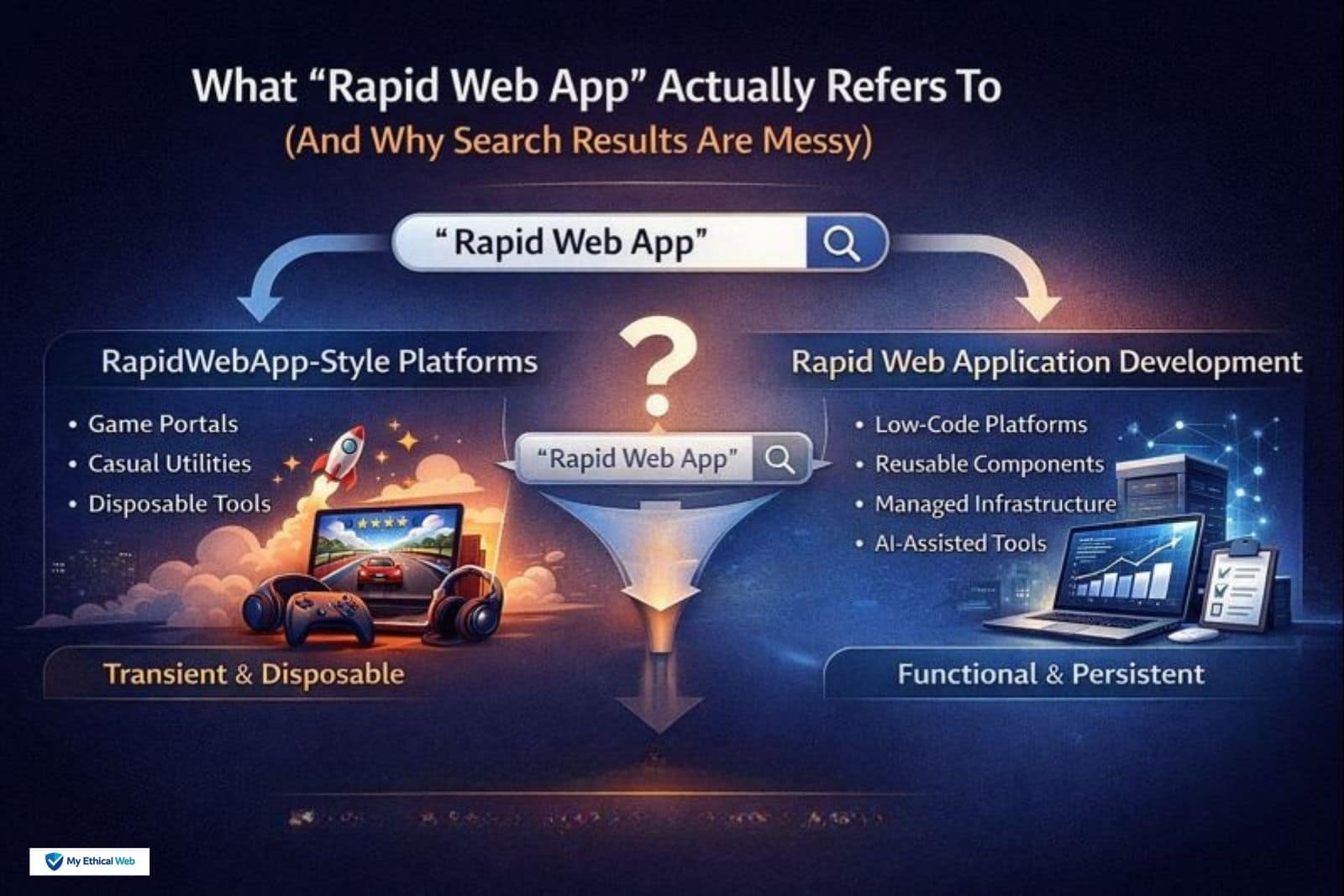
A rapid web app can describe two unrelated things that happen to share a name.
One is RapidWebApp-style platforms: browser-based portals hosting instant games or lightweight utilities that reset on refresh and require no persistence.
The other is Rapid Web Application Development (RWAD): a development approach rooted in rapid application development (RAD) principles, focused on shipping functional software quickly using managed infrastructure, low-code development platforms, reusable components, and AI-assisted tooling.
Search engines collapse these meanings. Humans don’t.
That gap is where frustration starts.
Rapid Web Application Development, Defined for 2026
Rapid Web Application Development (RWAD) is a development approach that prioritizes speed over low-level control by using low-code development platforms, managed infrastructure, reusable components, and AI-assisted development tools to shorten delivery timelines while accepting architectural constraints.
Speed is the promise.
Constraints are the price.
Unlike traditional web development—where teams design systems exhaustively before launch—RWAD emphasizes iteration, early release, and progressive refinement based on real user behavior.
It works.
But not everywhere.
Where Rapid Web Application Development Performs Well
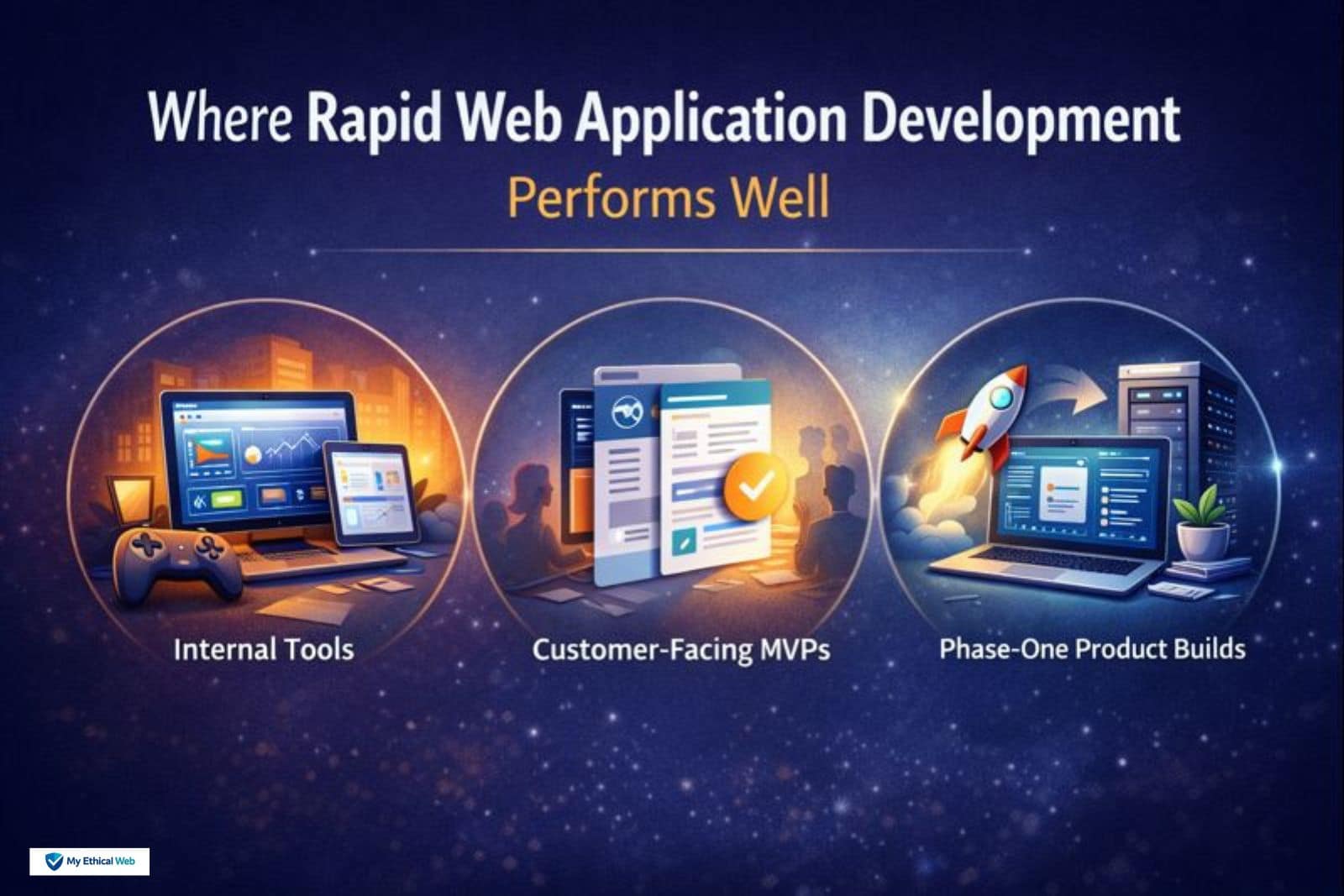
Rapid approaches shine when the problem is clear but the timeline isn’t negotiable.
The strongest use cases include:
-
Internal tools
Dashboards, admin panels, reporting systems, workflow automation. Software employees tolerate as long as it works. -
Customer-facing MVPs
Especially when market validation matters more than architectural purity. -
Phase-one product builds
Increasingly common in 2026: teams launch quickly using rapid platforms, then migrate critical components to custom stacks later.
That hybrid model wasn’t common five years ago.
It’s normal now.
Where Rapid Development Starts to Strain at Scale
The cracks rarely appear on day one.
They surface later—when usage grows, permission models multiply, or compliance questions land in someone’s inbox.
Most rapid platforms rely on shared database clusters and auto-generated APIs. That architecture scales well until concurrency spikes. In practice, latency issues often emerge below 10,000 active users, particularly for data-heavy or permission-sensitive workflows.
This aligns with benchmarking studies comparing low-code platforms to traditional development, which show that while low-code can accelerate delivery, traditional builds remain more robust for high-concurrency enterprise applications.
This doesn’t mean rapid web apps can’t scale into enterprise web applications.
It means they scale differently—and require discipline earlier than most teams expect.
Low-Code vs No-Code in 2026: Why One Scales and the Other Breaks
Pure no-code tools had a moment.
They were charming. Almost romantic.
Drag. Drop. Ship.
But by late 2025, industry sentiment shifted. Both Gartner and IBM noted that long-term production systems increasingly favor low-code, not no-code.
The reason is simple: abstraction breaks.
When it does, teams need an escape hatch.
Low-code provides that.
No-code rarely does.
No-code still matters—as a prototyping layer or business-side sandbox—but sustainable, scalable web applications almost always require custom logic eventually. Pretending otherwise just delays the reckoning.
Key Concept: Low-Code vs No-Code
-
No-code optimizes for accessibility and speed
-
Low-code preserves speed while allowing selective customization when abstraction stops being helpful
WebAssembly Quietly Changed the Performance Ceiling
There was a time when asking a browser to do anything computationally serious felt reckless.
Fans spun. Tabs crashed. JavaScript got blamed.
That era is over.
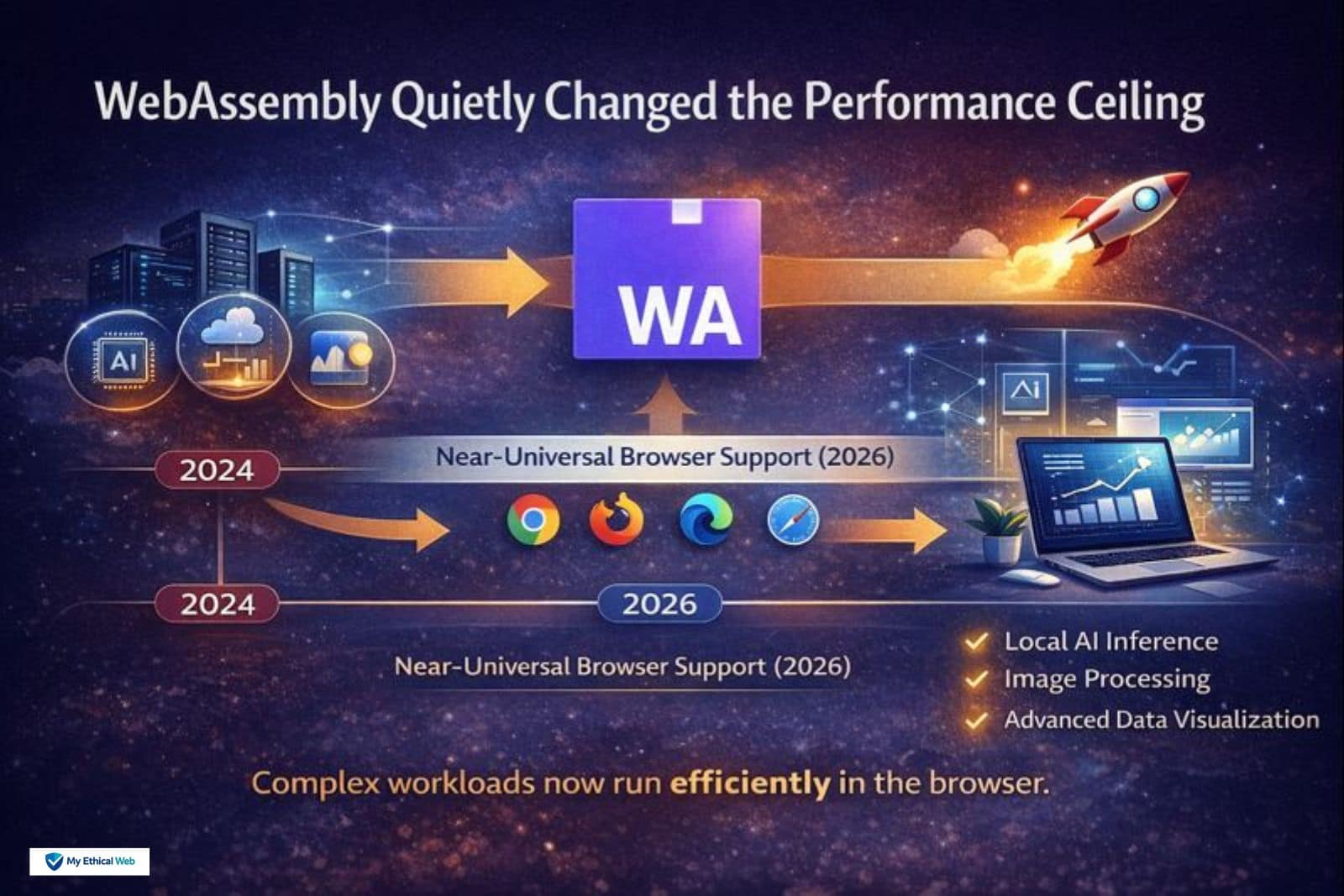
By 2026, WebAssembly (Wasm) is no longer hyped—and that’s how you know it won. With near-universal browser support and a stabilized toolchain (Wasm 3.0 shipped in late 2025), heavy client-side logic is now routine.
Image processing.
Local AI inference.
Advanced data visualization.
Workloads that once required backend services now run comfortably in the browser.
For rapid web apps, Wasm raises the performance ceiling without forcing a full rewrite.
Not everywhere.
Not automatically.
But decisively.
Short sentence.
Big shift.
Browser Privacy Turned Speed Into a Tax
Modern browsers enforce privacy by default.
Safari and Firefox block third-party cookies outright. Chrome still allows choice—but the direction is clear.
The impact is subtle but expensive: analytics break quietly.
Rapid web apps that relied on passive tracking or third-party scripts now require first-party data logic to understand user behavior at all. That logic takes time to design. And time erodes the speed advantage rapid platforms promise.
Privacy didn’t kill rapid development.
It just made shortcuts visible.
Key Concept: Browser Privacy & Rapid Apps
As browsers restrict third-party tracking, rapid web apps must design and own first-party data flows earlier to maintain visibility into user behavior.
Why Governance Determines Whether Rapid Web Apps Survive
Most failures blamed on “platform limitations” are actually governance failures.
Visual builders make it easy to ship UI quickly.
They also make it easy for ten people to ship ten variations of the same logic.
Over time:
-
Rules drift
-
Interfaces fragment
-
Nobody knows which version is canonical
That chaos is slow. Painfully slow.
The teams that succeed with rapid development don’t necessarily move faster—they argue less. They enforce design systems early. They centralize permissions. And they decide who owns data models before things get interesting.
Governance sounds boring.
It isn’t optional.
A Short, Messy Scenario (Because Reality Is)
A reporting dashboard launches in three weeks. Everyone’s impressed.
A month later:
-
Sales wants custom views
-
Ops wants audit logs
-
Legal asks about access history
The platform can handle all of it—but nobody agreed on standards.
Each team solves the problem their own way.
Six months in, the app still works.
But every change takes longer than it should.
Not because the tool failed.
Because decisions were deferred.
That’s the trade.
Rapid Web Application Development vs Traditional Web Development (2026)
| Metric | Rapid Web App Development | Traditional Development |
|---|---|---|
| MVP timeline | 2–4 weeks | 3–5 months |
| Performance ceiling | Medium–High (with Wasm) | High |
| Governance effort | Front-loaded | Back-loaded |
| Customization | Selective | Total |
| Best fit | Internal tools, evolving products | Regulated, high-scale systems |
No winner.
Just fit.
Common Mistakes in Rapid Web App Projects
-
Treating visual builders as self-governing
-
Delaying permission models
-
Assuming analytics “just work”
-
Over-automating business logic
-
Ignoring accessibility audits
-
Letting UI patterns drift
-
Believing speed eliminates planning
Speed changes when you plan—not whether you plan.
Practical Takeaways
For product leaders
-
Enforce one design system early
-
Decide data ownership before launch
-
Expect privacy work now—not later
For builders
-
Use low-code, not pure no-code, for longevity
-
Reach for WebAssembly only when JavaScript hits limits
-
Centralize logic before scaling users
Not heroic.
Just effective.
Frequently Asked Questions
Q. Is rapid web application development suitable for enterprise software?
Yes—selectively. It works best for internal tools and modular systems. Core regulated workflows often require custom builds or hybrid approaches.
Q. Do rapid web apps scale past 10,000 users?
They can, but shared infrastructure and auto-generated APIs often introduce latency unless carefully managed.
Q. Is no-code still relevant in 2026?
Yes, primarily for prototyping and business experimentation. Long-term production systems increasingly rely on low-code instead.
Q. Does WebAssembly replace JavaScript?
No. It complements it. Wasm handles heavy computation; JavaScript still orchestrates application logic.
Q. How do browser privacy changes affect rapid apps?
They require first-party analytics and explicit data design earlier, reducing reliance on passive tracking.
Final Thought
Rapid web application development isn’t about skipping work.
It’s about choosing which work happens first.
Speed feels good early.
Structure feels good later.
In 2026, the teams that last understand both.
For more insights on digital services, ethical web platforms, and how technology shapes everyday life, visit My Ethical Web.
| Disclaimer: This article is for informational purposes only and reflects general industry observations as of 2026. It does not constitute technical, legal, or professional advice. |