
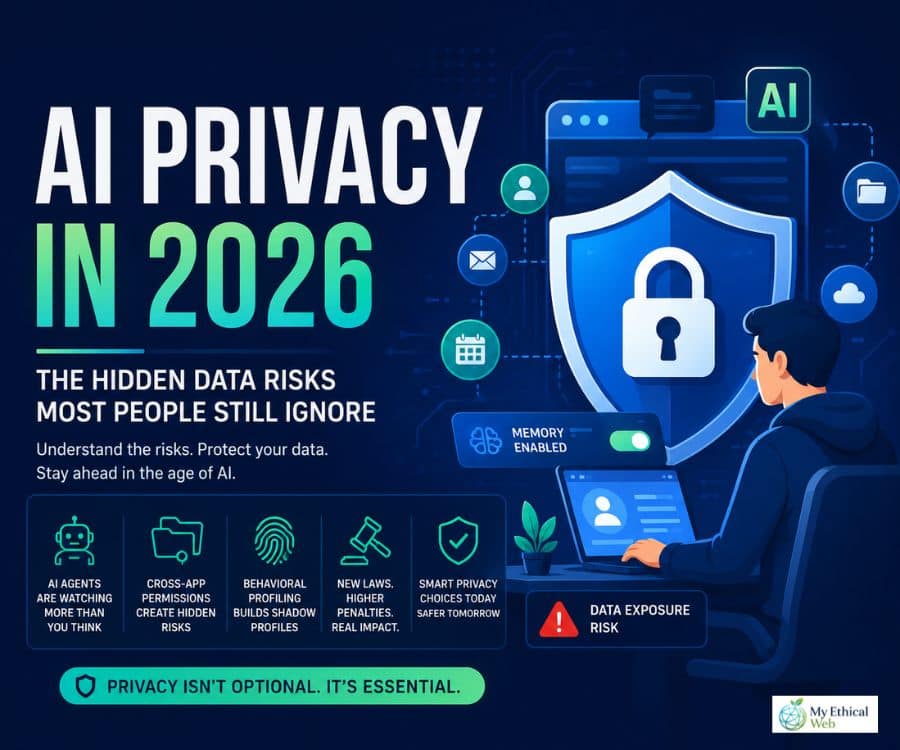
AI privacy stopped being a niche tech debate the moment AI systems became personal.
Your chatbot remembers preferences. Your AI assistant reads your calendar and your phone summarizes conversations. AI agents now connect to email, cloud drives, payment tools, and workplace apps — often without users fully understanding what permissions they’ve granted.
That’s the real shift in 2026.
The privacy risk is no longer just “AI collecting data.”
It’s AI building behavioral context.
Every uploaded document, synced workspace, voice sample, prompt history, and memory-enabled interaction contributes to a growing profile that modern AI systems can analyze, predict, and sometimes retain far longer than users expect.
At the same time, regulators are tightening enforcement. The European Union AI Act is reshaping how high-risk AI systems operate. Switzerland’s revised revFADP introduced personal criminal liability for some privacy violations. Enterprise security teams are scrambling to contain “Shadow AI” usage inside organizations.
Meanwhile, most people still treat AI tools like private conversations.
That assumption is becoming dangerous.
This guide explains:
- what AI privacy actually means,
- the biggest AI privacy risks in 2026,
- how AI agents changed the threat model,
- which laws now apply,
- and how to protect your personal and business data before convenience turns into permanent exposure.
What Is AI Privacy?
AI privacy refers to the protection of personal data, behavioral information, biometric identifiers, and digital activity when artificial intelligence systems collect, process, store, analyze, or learn from user data.
AI privacy includes:
- chatbot conversations,
- facial recognition systems,
- AI assistants,
- recommendation algorithms,
- AI agents,
- memory systems,
- training datasets,
- and automated profiling.
In simple terms: AI privacy is about controlling what AI systems know about you — and what they do with that information afterward.
Why AI Privacy Became a Bigger Problem in 2026
Older AI systems mostly reacted to isolated prompts.
Modern AI systems behave differently. They maintain memory, connect to external apps, access persistent context, and personalize responses over time.
That changes the equation completely.
A chatbot forgetting your conversation was one thing. An AI agent connected to your inbox, cloud storage, browser, work tools, and payment systems creates a much deeper privacy challenge.
The architectural difference between a passive chatbot and a proactive AI agent is exactly where the privacy gap opens up.
Convenience scaled faster than user awareness.
The 2026 Privacy Shift: AI Agents Changed Everything
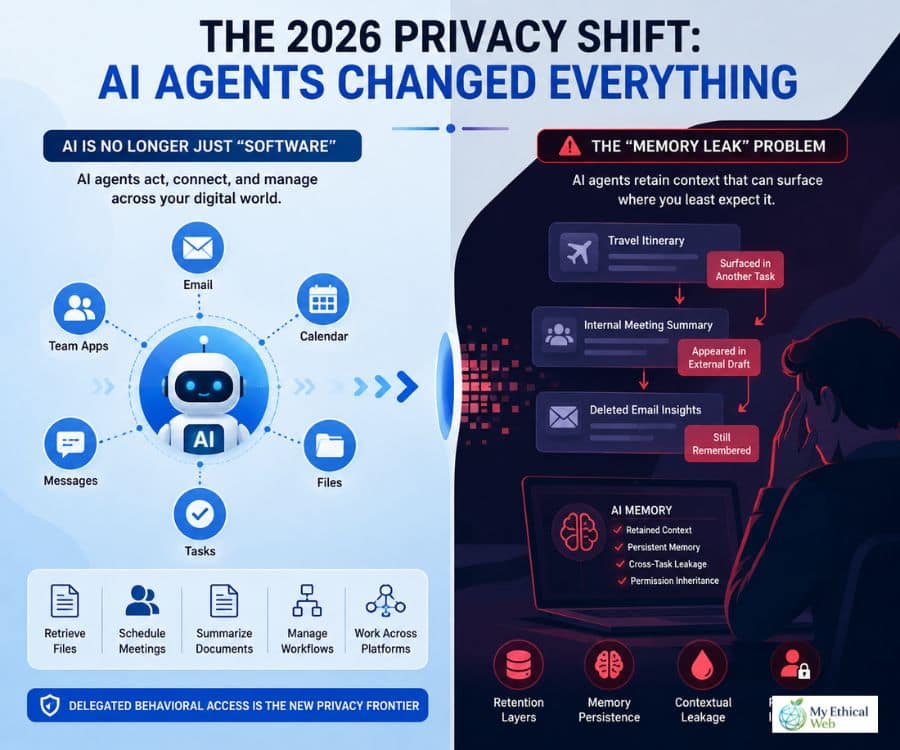
AI Is No Longer Just “Software”
The biggest misunderstanding in 2026 is thinking AI tools are still passive assistants.
They’re not.
AI systems increasingly behave like semi-autonomous operators capable of:
- retrieving files,
- scheduling meetings,
- summarizing documents,
- managing workflows,
- and interacting across multiple platforms simultaneously.
That introduces a new privacy category: delegated behavioral access.
Instead of seeing one prompt, AI systems now observe patterns.
And patterns reveal far more than isolated data points ever could.
The “Memory Leak” Problem
During multiple enterprise security audits in early 2026, researchers documented incidents where AI systems exposed fragments of retained contextual memory across unrelated workflows.
The surprising part wasn’t the breach itself.
It was how invisible the exposure felt.
A travel itinerary referenced in one workflow unexpectedly surfaced in another. Internal meeting summaries appeared inside AI-generated drafts intended for external communication. Context persisted longer than users assumed — and in some cases, AI agents retained summarized knowledge of emails even after the original messages were deleted.
That effectively created residual shadow archives of communications.
This is why modern AI privacy discussions increasingly focus on:
- retention layers,
- memory persistence,
- contextual leakage,
- and permission inheritance.
The problem is no longer just data collection.
It’s contextual accumulation.
The Privacy Trap: Why Convenience Became a Data Goldmine
AI Systems Collect More Than Most Users Realize
Modern AI platforms collect:
- prompts,
- voice inputs,
- behavioral interactions,
- device metadata,
- app connections,
- search history,
- location signals,
- and usage patterns.
Some systems also analyze:
- typing behavior,
- interaction frequency,
- productivity habits,
- emotional tone,
- and preference changes over time.
Most people never notice this happening because the interface feels conversational.
That’s the trap.
The smoother AI becomes, the easier it is to forget you’re interacting with a large-scale behavioral analysis system.
The Biggest Mistake Users Still Make
People routinely upload:
- contracts,
- customer databases,
- legal documents,
- medical records,
- financial spreadsheets,
- and internal company data
into public AI systems.
Not because they’re careless — because the interface feels private.
It often isn’t.
Many consumer AI systems still retain prompts for optimization, safety review, or model improvement. Understanding whether AI chatbots publish your data before uploading anything sensitive is now basic digital hygiene.
How AI Companies Really Handle Your Data
Not Every AI Platform Uses Data the Same Way
One of the biggest misconceptions around AI privacy is assuming all providers follow similar policies.
They don’t.
Some systems:
- retain prompts,
- use conversations for training,
- enable memory by default,
- or sync behavioral data across products.
Others isolate enterprise environments entirely.
The differences matter more in 2026 than they did even a year ago.
AI Privacy Comparison Table (2026)
| AI Platform Type | Typical Data Policy | Main Privacy Risk |
|---|---|---|
| Consumer AI chatbots | Often retain prompts for optimization | Sensitive information exposure |
| Enterprise AI suites | Segmented environments | Internal misuse |
| Open-source local LLMs | Local processing possible | Misconfiguration risks |
| AI search assistants | Behavioral logging common | Profiling and tracking |
| AI agents with app access | Persistent contextual memory | Permission inheritance |
Opt-In vs Opt-Out Training Models
| AI Model Type | Default Training Behavior | User Control |
|---|---|---|
| Consumer chatbots | Frequently opt-out | Medium |
| Enterprise deployments | Usually isolated | High |
| On-device AI | Local processing | Very High |
| Open-source local AI | No cloud training | Very High |
This distinction has become one of the biggest deciding factors for privacy-conscious users in 2026.
The MCP Problem: Cross-App AI Permissions Nobody Understands Yet
What Is Model Context Protocol (MCP)?
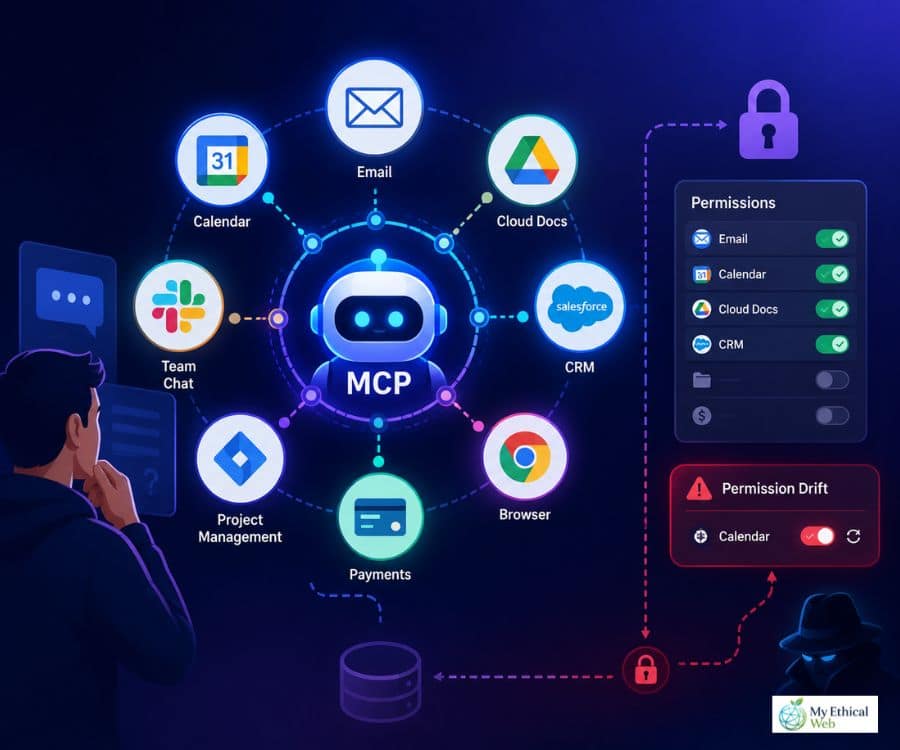
Model Context Protocol (MCP) is an emerging framework that allows AI systems to interact with apps, APIs, cloud services, and persistent memory layers through connected contextual permissions.
In practical terms: MCP helps AI systems remember and operate across platforms.
That sounds useful.
It also creates entirely new privacy risks.
Why MCP Changes the Threat Model
Traditional chatbots mostly processed isolated interactions.
Agentic AI systems now connect to:
- email,
- calendars,
- cloud documents,
- CRMs,
- browsers,
- project management systems,
- and payment tools simultaneously.
This creates:
- persistent delegated access,
- cross-platform behavioral mapping,
- and hidden permission chains.
One recurring issue in 2026 is “permission persistence drift.”
That happens when users revoke access in one app, but connected AI systems retain indirect contextual access elsewhere.
The result: exposure becomes difficult to trace.
Understanding the full difference between AI agents and chatbots is essential before granting either type of system access to personal or workplace data.
Agent Kill-Switch: How to Revoke AI Agent Permissions
Revoking access to an AI agent is not the same as deleting chat history.
Most AI agents rely on OAuth tokens issued by connected services — not just permissions inside the AI dashboard itself.
To fully disconnect an AI agent:
- Go directly to the connected service (Google Workspace, Microsoft 365, Slack, Notion, etc.).
- Open its own security or connected apps settings.
- Revoke the OAuth token issued to the AI wrapper.
- Check the AI system’s own memory settings separately.
- Delete stored context manually if the option exists.
Revoking access stops future data flow.
It does not automatically erase what the AI already processed or stored.
Shadow AI: The Enterprise Risk Exploding in 2026
What Is Shadow AI?
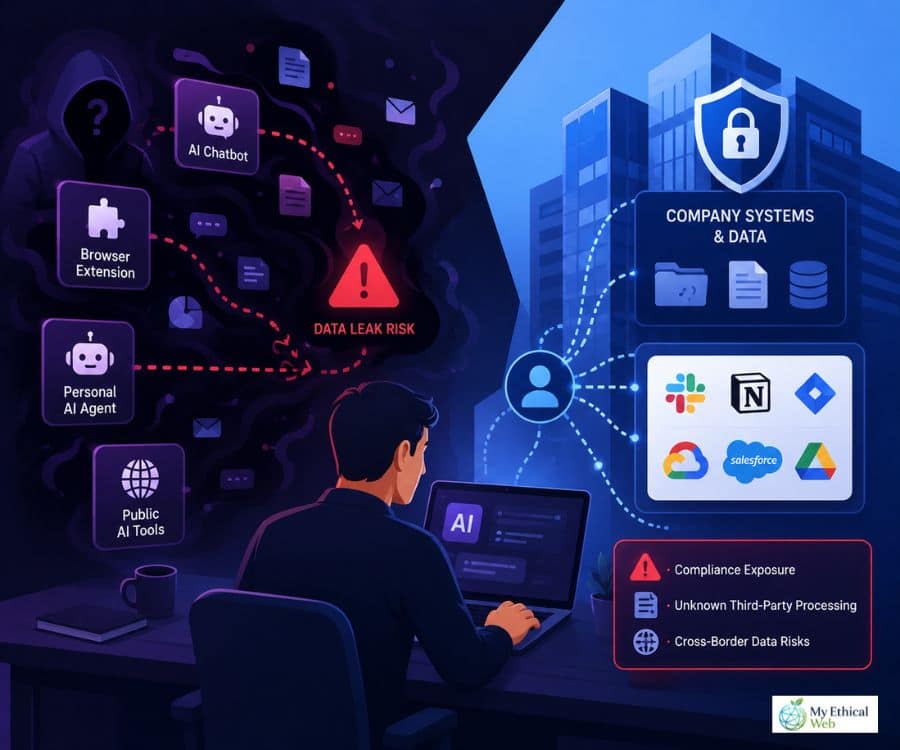
“Shadow AI” refers to employees using unauthorized AI tools, browser extensions, copilots, or personal AI agents outside approved enterprise systems.
Security teams increasingly compare it to the early “Shadow IT” era — except these systems actively learn from the data they access.
Why Companies Are Worried
The biggest enterprise AI leaks are no longer traditional hacks.
Increasingly, they happen because employees:
- paste internal data into public AI tools,
- connect personal AI agents to workplace apps,
- sync external copilots with company systems,
- or install AI browser extensions that scrape enterprise dashboards.
Security teams repeatedly discovered employees had connected personal AI assistants to:
- Slack,
- Notion,
- Jira,
- Salesforce,
- Google Workspace,
- and internal documentation systems
without formal approval.
That creates:
- compliance exposure,
- unknown third-party processing,
- and cross-border data transfer risks.
Synthetic Data and the Rise of “Shadow Profiles”
Synthetic Data Isn’t Automatically Private
Many AI companies now claim they train models using synthetic datasets instead of real user information.
The assumption is that synthetic data equals privacy safety.
That assumption is incomplete.
The New Concern: Behavioral Reconstruction
Privacy researchers increasingly warn that synthetic datasets can still preserve:
- behavioral fingerprints,
- demographic patterns,
- and inferential identity signals.
This creates the possibility of “shadow profiles” — situations where AI systems learn statistically accurate representations of individuals even after identifiable information is removed.
That legal gray area is becoming one of the biggest unresolved AI privacy debates in 2026.
AI Privacy Laws in 2026
GDPR and AI Systems
The European Union GDPR remains one of the world’s most influential privacy frameworks affecting AI companies.
It requires organizations to:
- justify data collection,
- explain automated processing,
- minimize retention,
- and provide deletion rights.
For AI systems, that becomes complicated when memory systems retain contextual information indefinitely.
The EU AI Act
The European Union AI Act introduced additional rules for high-risk AI systems.
Key focus areas include:
- biometric surveillance,
- law enforcement AI,
- foundation model transparency,
- and systemic risk obligations.
Full enforcement powers — including fines reaching €35 million or 7% of global annual turnover — are active from August 2026.
Why Swiss AI Privacy Law Hits Harder
Unlike GDPR, Switzerland’s revised revFADP introduced personal criminal liability.
Fines of up to CHF 250,000 can apply directly to responsible individuals — not just organizations — for intentional data protection violations.
That creates major accountability pressure for:
- compliance officers,
- executives,
- and AI data controllers.
This is one reason many multinational AI deployments now isolate Swiss user data separately.
The Technologies Trying to Fix AI Privacy
Differential Privacy
Differential privacy adds statistical noise to datasets so AI systems can learn patterns without exposing identifiable individuals.
It’s increasingly used in:
- healthcare AI,
- recommendation systems,
- analytics,
- and synthetic dataset generation.
Federated Learning
Federated learning allows AI models to train locally on user devices instead of sending raw data to centralized servers.
As on-device AI expanded across phones and laptops, federated learning became far more important for privacy-conscious systems.
Homomorphic Encryption
Homomorphic encryption allows AI systems to process encrypted data without fully decrypting it first.
It remains resource-intensive, but adoption is growing in:
- banking,
- healthcare,
- defense,
- and government AI systems.
Zero-Knowledge Proofs
Zero-knowledge systems verify information without exposing the underlying data itself.
They are increasingly important for:
- secure authentication,
- privacy-preserving identity systems,
- and AI verification frameworks.
AI Privacy vs AI Security
| AI Privacy | AI Security |
|---|---|
| Focuses on personal data rights | Focuses on system protection |
| Concerned with consent and retention | Concerned with breaches and attacks |
| Includes surveillance risks | Includes hacking risks |
| User-centric | Infrastructure-centric |
Strong security does not automatically guarantee strong privacy protections.
A perfectly secure AI system can still collect far too much behavioral data.
How to Protect Yourself From AI Privacy Risks
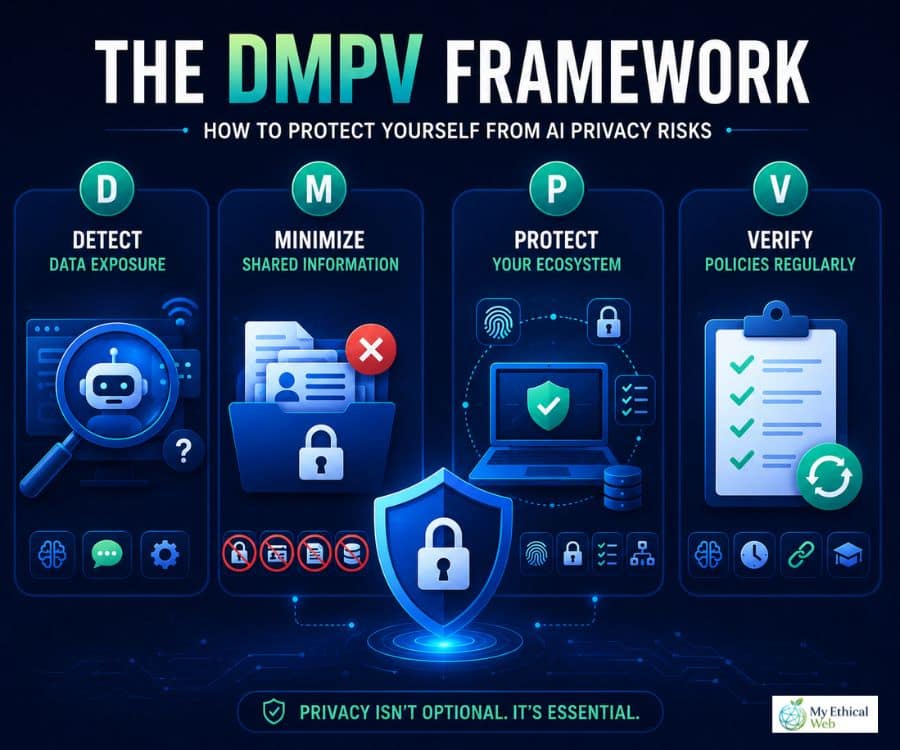
The DMPV Framework
D — Detect Data Exposure
Ask:
- Is memory enabled?
- Are prompts retained?
- Is training enabled?
- Does the AI connect to external apps?
M — Minimize Shared Information
Never upload:
- passwords,
- financial records,
- government IDs,
- confidential contracts,
- customer databases,
- or sensitive internal business documents
into public AI systems.
P — Protect Your Ecosystem
Use:
- multi-factor authentication,
- encrypted storage,
- permission audits,
- device segmentation,
- and enterprise AI policies.
V — Verify Policies Regularly
Privacy policies change constantly.
Review:
- memory settings,
- retention timelines,
- connected apps,
- and training permissions quarterly.
2026 AI Privacy Audit Checklist
Before connecting any AI tool to a personal or work account, ask:
- Is memory enabled by default?
- Can memory be disabled?
- Does the provider train on conversations?
- Are chat history and training separate settings?
- What OAuth permissions are requested?
- Are those permissions proportionate?
- Does the provider separate enterprise and consumer data?
- Have you reviewed connected OAuth tokens this quarter?
- Are AI browser extensions scraping active tabs?
- Which third-party processors are involved?
Common AI Privacy Mistakes
Treating AI Like Private Therapy
This remains surprisingly common.
People disclose:
- personal trauma,
- confidential business disputes,
- financial struggles,
- and medical concerns
inside systems they barely understand.
The conversational interface creates false intimacy.
Forgetting About Connected Permissions
Users often revoke app access or delete chat history while forgetting:
- browser extensions,
- synced cloud accounts,
- and connected AI agents
still retain access elsewhere.
Assuming “Deleted” Means Gone Forever
In some systems, deletion removes visibility — not necessarily retention across all infrastructure layers.
That distinction matters far more than most users realize.
The Future of AI Privacy
On-Device AI Will Become a Major Advantage
One of the biggest shifts happening now is the rise of:
- local AI,
- edge inference,
- and on-device processing.
Instead of sending every interaction to the cloud, AI increasingly runs directly on phones and laptops.
That reduces:
- centralized retention,
- behavioral aggregation,
- and cloud exposure.
Privacy is rapidly becoming a competitive feature. It’s also worth considering the environmental impact of AI chatbots — on-device processing reduces not just privacy exposure but also the energy cost of centralized cloud inference.
AI Regulation Will Expand Faster Than Most Companies Expect
Governments worldwide are introducing:
- AI transparency laws,
- biometric restrictions,
- synthetic media regulations,
- and mandatory risk disclosures.
The era of “collect everything first and figure it out later” is slowly ending.
Conclusion
AI privacy in 2026 is no longer just about data collection.
It’s about:
- persistent memory,
- behavioral profiling,
- cross-platform permissions,
- synthetic identity reconstruction,
- and AI systems that increasingly operate like autonomous digital operators.
The uncomfortable reality is this:
Most people still interact with AI as if it’s temporary.
Modern AI systems are increasingly designed around persistence.
That doesn’t mean AI is inherently unsafe.
It means users, businesses, and regulators are still adapting to what AI became far faster than they expected.
The smartest approach now isn’t avoiding AI completely.
It’s understanding where convenience quietly turns into exposure — and setting boundaries before the system sets them for you.
FAQs
Q. Is AI privacy getting worse in 2026?
In some ways, yes.
The biggest shift is that AI systems now retain more contextual memory for longer periods than older chatbot systems ever did.
Q. Can AI track my location?
Yes.
Modern AI systems can infer location using:
- IP patterns,
- Wi-Fi networks,
- metadata,
- device behavior,
- and app usage patterns.
Q. What is the biggest AI privacy risk right now?
For consumers: persistent memory systems.
For enterprises: Shadow AI and unauthorized AI integrations.
Q. Are AI conversations private?
Not always.
Some AI systems retain prompts, use conversations for training, or store contextual memory.
Privacy depends heavily on provider policies and settings.
Q. What is synthetic data?
Synthetic data is artificially generated information designed to replicate real-world patterns without directly exposing real user records.
However, researchers warn that behavioral patterns can still persist.
Q. What is Shadow AI?
Shadow AI refers to employees using unauthorized AI tools, copilots, browser extensions, or AI agents outside approved enterprise systems.
Q. What’s the safest type of AI for privacy-conscious users?
Generally:
- on-device AI,
- local LLMs,
- and isolated enterprise deployments
offer the strongest privacy protection because data stays local instead of continuously flowing to centralized cloud systems.
Q. What’s the difference between an AI agent and a chatbot?
A chatbot responds to prompts and stops.
An AI agent can:
- perceive context,
- plan tasks,
- connect apps,
- and operate across systems autonomously.
That increased autonomy creates deeper privacy risks.
Q. Should I worry about how AI retrieves stored context?
Yes.
Memory-enabled AI systems often rely on retrieval architectures that connect language models to stored documents, external databases, or vectorized knowledge systems.
What gets stored directly affects what the AI can later retrieve and surface.
Related: What Is a RAG Pipeline? 2026 Deep Dive
Disclaimer: This article is intended for educational and informational purposes only. AI privacy policies, regulations, and platform features change frequently, so always review official documentation and consult qualified legal or cybersecurity professionals before making sensitive privacy or compliance decisions.