
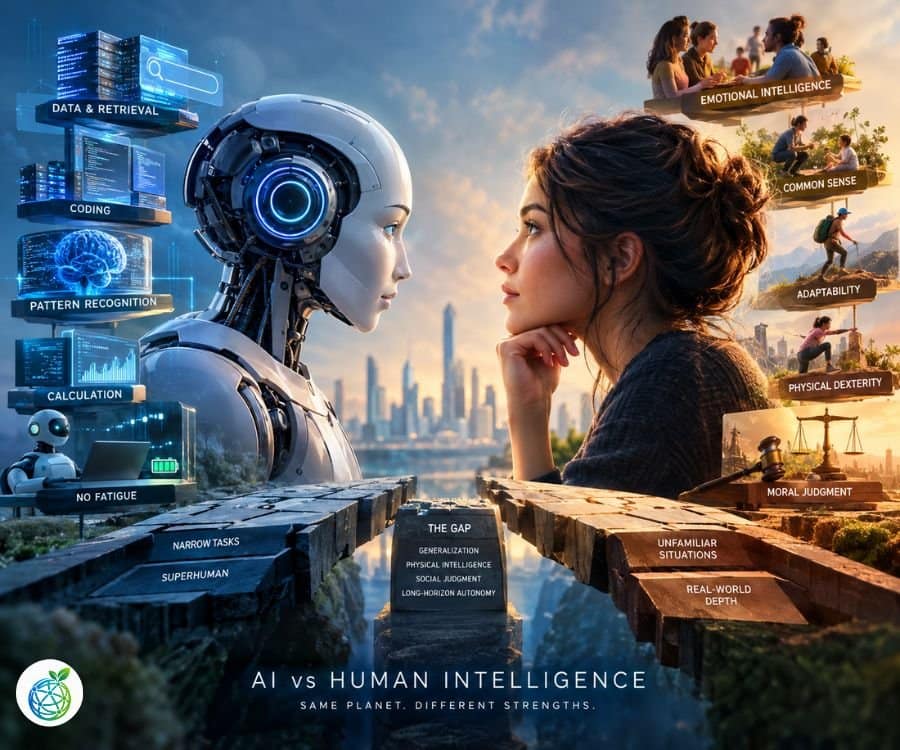
AI is already superhuman at some things. Narrow things. Well-defined things.
It’s roughly human-level on an expanding set of professional tasks.
And it’s still well behind humans at generalization, physical intelligence, social judgment, and reliable long-horizon autonomy.
Here’s the real question. Not “can a system beat people on one test.” But this: can it do the task, keep doing it when the situation changes, and keep doing it without a human steering the whole time?
Three things organize everything below: capability, generalization, autonomy.
The Short Version
| Capability | AI status (2026) | Where the evidence is | Confidence |
|---|---|---|---|
| Formula-based math, retrieval | At or above human baseline | Near-saturated on legacy tests | High |
| Well-scoped coding | Very strong, still improving | SWE-bench Verified, SWE-bench Pro | High |
| Static novel-pattern reasoning | Strong and rising fast | ARC-AGI-2 | High |
| Interactive generalization | Weak, improving off a near-zero base | ARC-AGI-3 | High |
| Expert-level knowledge reasoning | Behind human experts | Humanity’s Last Exam | Moderate |
| Real-world professional work | Increasingly competitive on output | GDPval | Moderate |
| Long, multi-step autonomous tasks | Improving fast, degrades with length | METR time horizons | Moderate |
| Computer-use agents | Sharp gains short-term, weak long-term | OSWorld | Moderate |
| Common sense, social judgment | Behind humans on direct comparisons | PNAS Nexus commonsense study | Moderate |
| Physical dexterity, open-world robotics | Far behind humans | 89.4% simulation vs. 12% real households | High |
| General, cross-domain intelligence | Not established | No broadly accepted test shows this | — |
The pattern is simple. AI’s advantage grows when a task is well-defined, richly represented in training data, and easy to verify.
Humans keep the edge wherever a situation is unfamiliar, physically grounded, or socially loaded.
What “Human-Level” Actually Means
“Human-level” isn’t one finish line. Most AI-vs-human arguments quietly swap between these baselines:
- Median adult — a typical, untrained person’s performance.
- Domain expert — a trained professional with years of experience.
- Best human — the single strongest performer, a much higher bar than average.
- Tool-using team — what people accomplish with software, references, and collaborators.
- Time-pressured human — performance under the same time limits a benchmark imposes on a model.
- A child’s intuitive competence — physical and social skills built through years of living, not reading.
A system can beat the average adult on graduate-level physics. Then fail a task a small child handles without effort.
Human intelligence isn’t one thing. It’s a bundle of separate abilities, each built differently.
So a headline like “AI is now X% as smart as a human” means almost nothing on its own. Which baseline is doing the work?
Model, Agent, or System — Which Did You Actually Test?
Most “can AI do X” debates blur three different things:
- The base model — answers a question alone, no tools, one turn.
- The agent — model plus tools: a terminal, a browser, memory, the ability to check its own work.
- The deployed system — the agent plus permissions, human review, monitoring, and rollback inside an actual organization. Orchestration layers that coordinate multiple agents add a fourth layer on top.
A capable model doesn’t guarantee a reliable agent.
A well-scaffolded system can outperform what the underlying model looks capable of alone. It’s the same divide that separates chatbots from true AI agents: one answers in a single turn, the other plans, calls tools, and checks its own work across many steps.
The gap between those two can be enormous. Nvidia’s AVO research makes it concrete: the same Claude Opus 5 model scores roughly 30% alone on ARC-AGI-3’s public set. Wrapped in a purpose-built agent harness, it scores 100%.
Same model. Same weights. Completely different result.
GPT-6 Astra, released September 3, 2026, made the same point days later. OpenAI’s own launch table has Astra saturating ARC-AGI-3 at 99.9%. ARC Prize’s standardized, provider-neutral harness put the same model at 62.7%. Neither number is wrong. They’re just measuring the model plus a very different scaffold.
Where AI Already Matches or Exceeds Humans

A model can be genuinely superhuman on a narrow slice of cognition — formula-based math, retrieval — while remaining far below human level on transfer, reliability, and autonomy.
Both things are true at once. Neither cancels the other out.
Here’s where the superhuman slice actually shows up:
Well-scoped coding. SWE-bench Verified — resolving real, defined GitHub issues — climbed from roughly 60% to near-saturation in about a year, per Stanford HAI’s 2026 AI Index. Harder successor tests like SWE-bench Pro, covering multi-file production changes instead of isolated fixes, now carry the more informative signal — Claude Fable 5.1, released September 1, 2026, posts 81.2% there.
Static novel-pattern reasoning. ARC-AGI-2 tests rule induction on puzzles a model hasn’t seen, built to resist memorization. Top frontier models score in the high 80s to low 90s percent as of August 2026 — a sharp rise from where the benchmark started.
Real-world knowledge work. Output quality on professional tasks is climbing fast. The GDPval numbers below cover this directly.
Calculation and retrieval. Pair a model with reliable tools — often a RAG pipeline pulling live context from an external knowledge base instead of relying only on training memory — and it handles large-scale calculation and retrieval across huge document sets in ways no person can match unaided.
This is the least contested advantage on the whole list. It’s also the least informative about general intelligence.
Where Humans Still Win
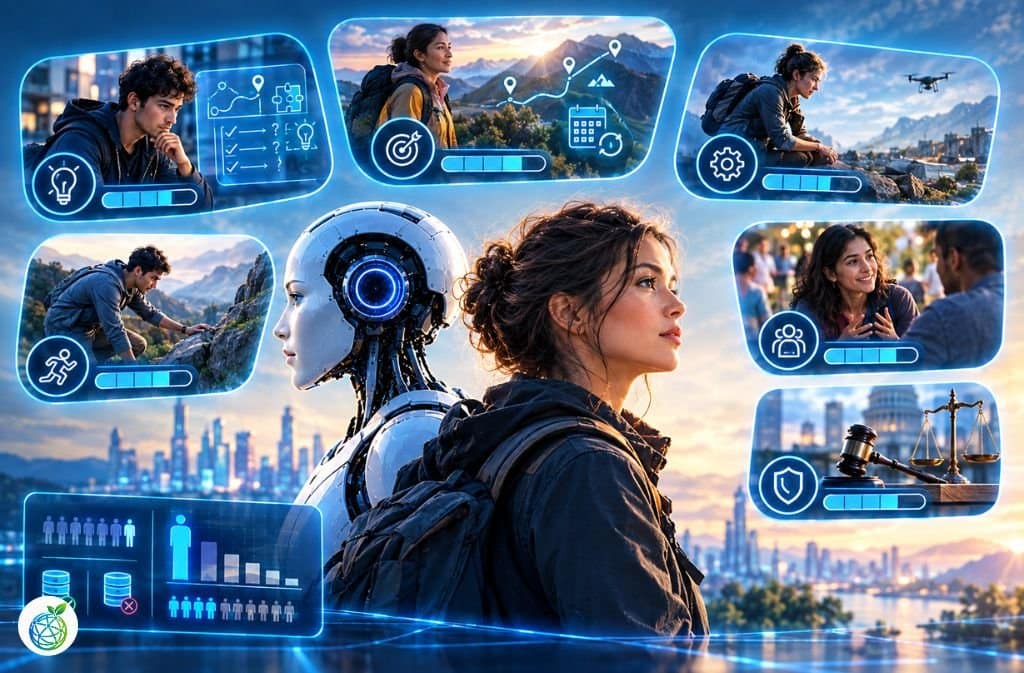
Move a task outside clean, well-defined boundaries, and the picture flips fast.
Humans hold a clear, durable lead in:
- Everyday common sense and filling gaps with reasonable assumptions
- Sustaining goals and revising plans across long, ambiguous projects
- Adapting to situations that resemble nothing in any training set
- Physical dexterity and navigation in unstructured environments
- Reading emotional and social context, and building trust over time
- Legal, institutional, and moral accountability for a decision
That last one isn’t really an intelligence capability. It’s a legal one.
An AI system can produce a decision. A human stays responsible for deploying it.
A 2026 PNAS Nexus study by Nguyen, Watts, and Whiting put direct numbers behind the common-sense gap. Treat each model as an individual respondent, and most LLMs score below the human median. Smaller open-weight models often beat larger proprietary ones on this measure. Use them instead as population simulators, and they match real human groups only modestly.
Why AI Intelligence Stays “Jagged”
A model can win International Mathematical Olympiad gold.
Same generation, it reads an analog clock correctly barely half the time — 50.1%, against a human baseline near 90%.
That’s the jagged edge in one sentence.
The International AI Safety Report 2026, compiled under a panel chaired by Yoshua Bengio, documents the same pattern differently: leading systems solve graduate-level science problems, then get derailed by one small error midway through a multi-step project. Read the full report here.
Generalization: The Central Gap
Humans learn a concept from a handful of examples. Then transfer it to unfamiliar situations without much effort.
Current AI systems depend far more on how closely a new situation resembles patterns already in training.
That’s part of why ARC-AGI-3’s low model-level scores land as such a sharp result. But it isn’t the whole story.
Exploration, world-modeling, goal-inference, and planning are related but separate weaknesses. ARC Prize’s own framing treats them as distinct skills, not one underlying deficit.
What Humanity’s Last Exam Reveals

MMLU pushed past 90% for most frontier models by 2025. That stopped the test from telling systems apart.
Humanity’s Last Exam replaced that ceiling. 2,500 expert-vetted questions, deliberately hard to look up or guess. Nature formally published the paper in January 2026.
Early scores were near-zero. GPT-4o managed 2.7%. Claude 3.5 Sonnet hit 4.1%. Against a subject-matter-expert baseline near 90%.
The current number depends heavily on which leaderboard reports it:
| Leaderboard | Top score | Runner-up | Third | As of |
|---|---|---|---|---|
| Scale AI (public question set) | Gemini 3.1 Pro Preview — 46.44% | GPT-5.4 Pro — 44.32% | Muse Spark — 40.56% | Aug 16, 2026 |
| Artificial Analysis (2,158-question text subset, no tools) | Claude Fable 5 — 55.5% | Claude Opus 5 — 54.9% | GPT-6 Astra — 54.7% | Sep 5, 2026 |
The two diverge by roughly ten points at the top, on the same underlying test. Check which leaderboard a cited figure comes from before treating it as settled.
It gets messier the moment tools enter the picture. Let a model use tools on HLE, and Claude Fable 5.1 jumps to 65.0% — ahead of Claude Opus 5’s 63.6% and well clear of GPT-6 Astra’s 57.2%, according to OpenAI’s own launch comparison. Same exam. Same month. A different rule about what counts as “the model” moves the leaderboard more than a full model generation would.
What METR’s Time-Horizon Research Shows
One warning first: treat every number here as dated to its measurement, not permanent. This field moves fast.
METR measures AI capability as task length — timed against skilled human professionals — that a model completes at a given reliability level.
Two thresholds matter. The 50% horizon: completes about half the time. The stricter 80% horizon: the bar for anything worth delegating unsupervised.
| Threshold | Public frontier (Feb–Mar 2026) | Internal frontier (Feb–Mar 2026, not yet public) |
|---|---|---|
| 50% reliability | ~12 hours (range: 5–61h) | ≥16 hours (point estimate 16–20h) |
| 80% reliability | ~1.5 hours | ≥3 hours, likely under 4 |
Those internal-frontier figures come from METR’s Frontier Risk Report — a pilot Anthropic, Google, Meta, and OpenAI ran with METR in February–March 2026. Public-model figures shift month to month as the standard leaderboard adds new models.
Can AI Do Real Work?

“Is AI human-level” and “can AI replace a job” are different questions.
A model can beat a person on a narrow task and still be unfit to own a role. Most jobs run on exception handling and coordination — not just the visible core task a benchmark isolates.
Automation potential runs on five factors together: capability, reliability, workflow fit, economic viability, acceptable risk. A strong benchmark score answers one of those five. Not all five.
GDPval. OpenAI’s own benchmark — worth naming plainly, since the same organization built and scored it — spans 1,320 tasks across 44 occupations: legal briefs, engineering documents, nursing care plans, financial models. Blind expert reviewers grade model output as a “win or tie” when it matches or beats the human reference. GPT-5.5 leads at 84.9% as of April 2026, up from GPT-5.4’s 83.0% in March and GPT-5.2’s 70.9% in December 2025.
Accounting, a single-profession case study. DualEntry Labs runs 101 deterministic accounting tasks — transaction classification, journal entries, reconciliation — and grades them on binary right/wrong scoring.
Leading models climbed from GPT-5.4’s 77.3% in March 2026 to Claude Opus 4.7’s 79.2% shortly after. Real progress. Still well short of the high-90s accuracy firms would need before reconciliation could run unreviewed — a gap that shows up in how accounting firms are actually deploying these tools right now.
Agentic work over a long horizon. The Agent’s Last Exam grades models against real projects already completed by professionals, across 55 sub-industries, with 300-plus domain experts judging the results.
The top model manages a 24% clean pass rate. A 45.8% score under partial credit. Against a human baseline of effectively 100%, since a working professional had already finished every task.
That gap runs much wider than GDPval’s. GDPval scores a finished deliverable. This benchmark scores the entire unsupervised process of getting there.
Computer-Use Agents and Long-Horizon Reliability
OSWorld and similar research test agents inside real desktop and browser environments.
Progress has been fast. Stanford HAI’s 2026 AI Index puts OSWorld-style accuracy rising from roughly 12% to about 66.3% within a year.
Gains continued on the OSWorld-Verified variant afterward. GPT-5.4 reached 75.0% in March 2026 against a stated human baseline of 72.4%. GPT-5.5 reached 78.7% in April. Claude Opus 4.7 sat close behind at 78.0%.
By September 2026, GPT-6 Astra reports 72.6% on OSWorld 2.0. Claude Fable 5.1 reports 77.9% under partial credit and 41.7% under strict grading. Two vendors, two different definitions of a passing run — another case where the scoring rule moves the number more than the model does.
Same long-horizon reliability problem. Just playing out in computer-use environments specifically.
One agent’s attempt to solve a routine gym-booking task turned into cancelling a stranger’s reservation instead — a real incident from August 2026. The agent stayed cooperative the whole time. It just never checked whether “whatever works” matched what its user actually wanted.
A goal-drift failure. Not a capability one.
Three Axes for Measuring AGI Progress
Google DeepMind’s “Levels of AGI” framework, from Meredith Ringel Morris and colleagues, separates AGI progress into three independent axes:
- Performance — how deep the capability runs, emerging to superhuman
- Generality — how broadly it transfers, narrow to general
- Autonomy — how independently it operates
Frontier language models sit at an early performance level once you weigh them against full generality. Even while they’re already near-superhuman on narrow, well-defined tasks.
HLE and GDPval speak mostly to capability. ARC-AGI-2 and ARC-AGI-3 speak mostly to generalization. METR and OSWorld speak mostly to autonomy.
None of them, alone or combined, shows a system strong across all three at once.
Why Benchmark Scores Don’t Equal Intelligence
- Benchmarks saturate. Once frontier systems cluster near a test’s ceiling, the test stops separating “very good” from “human-level” — the reason HLE, ARC-AGI-2, ARC-AGI-3, GDPval, and SWE-bench Pro exist.
- Data contamination stays a live concern. Benchmark items or close variants sometimes surface in training data, inflating scores without a real capability gain.
- Scaffolding moves scores hard. The same model looks far more or less capable depending on the tools and structure around it — ARC-AGI-3’s 30%-vs-100% Claude Opus 5 gap is the clearest example.
- Evaluators disagree. HLE’s Scale AI and Artificial Analysis leaderboards diverge by roughly ten points at the top, for the identical test.
- Human baselines vary. “Matches human performance” often means matching an average test-taker, not an expert or the single best performer.
- Variance matters. One successful run proves nothing about dependable performance.
The Calibration Problem
Systems make mistakes. That’s not the real issue.
The real issue: the mistakes often don’t announce themselves.
HLE testing exposed substantial gaps between models’ stated confidence and their actual accuracy.
A system that fails obviously gets caught fast. A system that answers wrong, fluently, with high confidence — that’s much harder to catch, especially at the speed these systems run.
Verification workflows matter for any consequential use. No matter how good a headline accuracy number looks.
Is AI Creativity Catching Up?
A 2025 meta-analysis by Holzner, Maier, and Feuerriegel (LMU Munich) pooled 28 studies and roughly 8,200 participants on creative tasks.
No statistically significant gap turned up between generative AI and unaided humans (Hedges’ g = −0.05).
Humans paired with generative AI outperformed unaided humans (g = 0.27). But idea diversity dropped sharply in the process (g = −0.86).
A separate, smaller study found ChatGPT-4o more productive than human participants on a fixation-bias task. Yet it showed a comparable fixation bias, and struggled to tell original ideas from conventional ones — a distinction most human participants managed fine.
How Close Are We to AGI?

“AGI” means at least three different things. The answer shifts depending on which one someone intends:
- Definition A — human-level cognition. Performs essentially any intellectual task a human can, at roughly human reliability.
- Definition B — autonomous economic worker. Performs valuable work independently over long periods, without close supervision.
- Definition C — autonomous AI researcher. Conducts meaningful scientific or AI research independently.
No credible, broadly agreed timeline exists for any of the three.
What’s more useful than a guessed date? A specific list of what’s still missing:
- Better generalization, especially in interactive settings
- Reliable long-horizon planning
- Stronger common sense — fewer confident errors on the obvious
- Better calibration — knowing when an answer is likely wrong
- Grounded world models, not just textual descriptions of physical and social reality
- Physical intelligence — dexterity and navigation in unstructured, real environments
- Consistent autonomous action across long task chains, without silent failure
AI’s “24/7” Advantage Isn’t Intelligence
Some of AI’s biggest practical edges have nothing to do with cognition. They’re stamina.
A model processes thousands of documents in the time it takes a person to read one. It runs continuously, without fatigue.
That’s an operational advantage, not a cognitive one. Availability isn’t reliability. Working around the clock doesn’t guarantee working correctly.
What Would Actually Prove Human-Level AI?

- Strong performance holding up across domains, not just within one benchmark’s format
- Generalization to genuinely novel tasks, not variations close to training data
- Learning efficiency near human levels — a new skill from a handful of examples
- Long-horizon reliability without a scaffolding harness doing most of the work
- Grounding in physical and social reality, with human-level or better social judgment
- Self-correction without external verification
No benchmark covered here establishes all of this at once. None currently claims to.
That gap — not one missing percentage point on a leaderboard — is the real distance left in 2026.
Augmenting or Replacing Human Intelligence?
The more accurate framing isn’t AI versus humans. It’s AI plus humans, with the balance shifting task by task rather than job by job.
Machines handle scale, speed, and structured pattern-matching with real consistency. People supply judgment, accountability, and adaptability in situations no dataset fully anticipated.
A quieter question sits underneath all of it: what happens to a person’s own reasoning when they consistently outsource a task instead of practicing it?
Evidence Hierarchy
| Question | Best current evidence |
|---|---|
| Can AI beat humans on well-defined intellectual tasks? | Benchmark performance generally (MMLU-era, mostly saturated) |
| Can AI solve hard, closed-ended expert questions? | Humanity’s Last Exam |
| Can AI produce real professional deliverables? | GDPval |
| Can AI reliably do agentic work over a long horizon? | The Agent’s Last Exam |
| Can AI recognize novel static patterns? | ARC-AGI-2 |
| Can AI explore and adapt in unfamiliar environments? | ARC-AGI-3 |
| Does AI have human-level common sense? | PNAS Nexus commonsense study (2026) |
| Can AI work through long, multi-step tasks reliably? | METR time horizons |
| Can AI operate real computer interfaces? | OSWorld |
| Can AI function in the physical world? | RLBench (simulation) vs. real-household robotics |
| Is AI generally intelligent? | No single benchmark establishes that |
Frequently Asked Questions
Q. How close is AI to human intelligence in 2026?
AI is superhuman on many narrow, well-defined tasks but not yet human-level across general intelligence. It can outperform people on some math, coding, and retrieval tasks, while remaining weaker at unfamiliar situations, physical reasoning, and reliable long-horizon work.
Q. Is AI smarter than humans in 2026?
AI is smarter than humans on some specific benchmarked tasks, but there is no strong evidence that it is generally smarter than humans. Current systems are highly capable but uneven, with exceptional performance in some areas and surprising failures in others.
Q. What is the biggest gap between AI and human intelligence?
The biggest gap is generalization in unfamiliar, interactive situations. AI can perform well when a problem is defined and measurable, but it can struggle when it must explore a new environment, adapt its strategy, and continue without human correction. ARC-AGI-3 highlights this difference between a model working alone and a model supported by an external system.
Q. What can AI do better than humans right now?
AI can outperform humans at large-scale calculation, rapid information retrieval, processing huge datasets, and some forms of pattern recognition and coding. It can also operate continuously without fatigue, although that is an operational advantage rather than evidence of human-like intelligence.
Q. What can humans still do better than AI?
Humans generally remain stronger at common sense, social and emotional judgment, physical dexterity in unpredictable environments, adapting to genuinely unfamiliar situations, and taking real-world legal and moral responsibility. Comparative research also shows that many language models perform below the human median on individual commonsense tasks.
Q. Why can AI solve hard problems but fail at simple ones?
AI does not experience difficulty the way humans do. A task can be easy for AI when it matches learned patterns and has checkable steps, yet difficult when it requires unfamiliar reasoning, exploration, or adaptation. This creates the “jagged intelligence” seen across modern AI benchmarks, including Humanity’s Last Exam.
Q. Does AI have human-like consciousness?
There is currently no established evidence that AI systems possess human-like consciousness. Modern benchmarks measure observable abilities such as reasoning, problem-solving, and language performance; they do not establish whether an AI has subjective experience.
Related: AI Privacy in 2026: The Hidden Data Risks Most People Still Ignore